Showing posts with label Myanmar. Show all posts

Thursday, January 22, 2015

One day in Inle Lake Region

We spent 2 nights and 1 day in the Inle Lake area. We took a bus from Bagan to the Nyaung Shwe area of Inle Lake. Someone recommended that we take the night bus, which turned out to be a great idea. We were able to avoid paying for a night at a hotel and drove through the scary, twisty-turny mountainous region between Bagan and Inle. I'm glad it was too dark to see anything, because I'm sure it was a lot of narrow roads and steep drop-offs.

We stayed at the Blissful Inn Nyaung Shwe. It was a good economy stay. We had a room with 2 twin beds and a private bathroom. The breakfast included eggs, fruit, and toast; which was balanced enough to be a good start to the day. The hotel was walking distance to the town center. While walking to the boats, we saw only a handful of tourists.

A girl that we met in Mandalay gave us the card of an independently owned tour boat operator. As luck would have it, the first man we approached happened to be the right guy! The wife and son of the owner took us out for the day. The woman's English was very good and she shared a lot of interesting information about Buddhism.

Fishing on Inle Lake
Since we were off to a late start, so there weren't many fishermen left on the lake. The first thing we saw was a man fishing with baskets off paddle board. He approached us and I think tried to sell us the fish he had just caught. In the back of the boat was a young boy, probably about 10, reading what look to be a text book. The lake was so serene. There were boats coming and going, and the odd fisherman along the way, but for the most part, it felt as if we were totally alone on the water. The lake is so huge that it took us almost 30 minutes to get from the dock to the network of tributaries where all the "attractions" live.

Our first stop was a silver workshop; one of those extra stops added into trips to try to encourage tourists to spend money. Unfortunately, we wanted to buy something, but were on a tight budget. I got the feeling that most of the tourists that had come through were rich older people. They were thoroughly unconvinced that we had a tight budget.

Our guide telling us about stupas.
She then took us to a huge market. We parked the boat and walked inland for about 10 minutes. This market had everything from souvenir trinkets to produce to meat. We quickly passed through the market and she lead us through a small pathway that ended in an open field with loads of stupas. From what I understand, stupas are usually donated by rich men to their hometown or a poor area that cant afford to build a temple or pagoda. I think that there are a lot of overlapping functions between temples, pagodas, and stupas, which is probably why I couldn't quite wrap my head around the differences at first.

Neck coils; woman with the longest neck in the background
One big struggle I faced was my desire to take pictures versus my desire to stay reverent. We were taken to a weaving shop where there were many different kinds of looms spread throughout. The looms themselves were huge yet delicate wooden machines, but the operators were what made this shop so special and unique. The woman with the longest neck in the world was by far the most interesting part of the shop. The process of elongating the neck starts with placing several copper coils around the neck and gradually increasing the number of coils. According to the tour guide, this practice is a little dangerous, but (as legend says) the rings protect the women from the tiger that killed a princess. As much as I wanted to take her picture, I felt that it would be disrespectful to just walk up and snap a picture. I decided to photograph her in macro. Happy medium, I thought. We had both planned on buying one thing each while on the lake, and we both settled on scarves made in the shop.

Cool setup of out lunch stop
Our lunch spot was interesting. The restaurant was actually in the lake! It consisted of a series of small stilted rooms connected by a walkway and connected to a main building with the kitchen. The food was good, but not very memorable. I've found at places with large volumes of tourists, the food tends to be a little "dumbed down." In this case, it wasn't a disappointment. It was so hot and we weren't very hungry because of the heat, so something a little more familiar was fine. We got a rice dish and a noodle dish to split and two regular Cokes.... we definitely needed a substantial calorie boost.

We had two more stops on our way back to the port. We passed through a village of incredible stilted homes. Talk about feats of engineering! The houses looked too big for the thin stilts they sat on. They each had similar looking boats tethered to a small dock. I had seen houses stilted over land, but never over water. A little scary! Its interesting that these communities are so self-sustaining. I'm curious though; where does their refuse go? Do they not produce any dangerous litter? The area was so clean, with the exception of the houses, it almost felt untouched.

Man picking flower
We passed through rows and rows of the stilted homes and then hit the open water portion of the lake again. We cut across the lake diagonally and then went off into another reed-lined tributary. Our guide pointed out the vegetation growing on the lake. It was so interesting that there were these mini farms growing on top of the water. Along the way, we started to pull over and our guide yelled over to a man picking flowers. I thought that maybe there was an issue with the boat, but it turned out that she just wanted to purchase some flowers because we were on our way to the temple where she and her family worship. She said she goes several times each day! The temple was this huge wooden structure that was absolutely int the middle of nowhere. Nothing around it except for water and reeds. From what I gather, she needed to pray again before dark. We got back onto the boat and were fortunate enough to be in the center of the lake with an unobstructed view of the sunset. Well what would have been unobstructed had it not been so hazy.

We headed back to the dock and thanked our guide. It really was an excellent and educational day. If I had anything to do over, I would have packed more water and slathered on an extra layer of sunscreen.

Monday, January 19, 2015

Bagan: Pagodas and stupas and temples: Oh My!

Overlooking the Hilo Minlo Temple, Old Bagan
Bagan is about to blow up. As a formerly forbidden beauty; its abundance of temples, reputation for a killer sunrise, and hot climate will surely make it a popular destination for expats living in Asia and touring seniors alike. While we were there, there were oodles of tour buses, mostly seniors touring from Australia, however we also encountered some Canadians and Americans in the mix. I was a little surprised at the number of families we saw. I’m always a little surprised when I see families in Asia outside of the resort portion of Phuket in Thailand. Southeast Asia has a bit of a reputation for having wild parties and loose regulations when it comes to drugs. If that’s what you’re looking for… don’t go to Bagan.

If Bagan has made it to your Myanmar “to do” list, I recommend going there first. If you have sought out cultural hot spots in any other Asian countries, you’ll know what it means to be “templed out.” There are so many Buddhist temples, pagodas and, stupas that it’s difficult to wrap your brain around what each is for (I have had it explained to me several times, and I still don’t get it). I don’t want to say that temples are all Bagan has to offer, but if you’re on a budget or pressed for time you’ll end up only doing temples. It’s worth it to note that when you enter Bagan (ie getting off the bus, at the airport, or at the boat port) you’ll pay a regional entry fee. You’ll pay something like $5 and receive a ticket that entitles you to enter many local cultural spots. We had only 2 nights and 2 full days to explore, with the added burden of a teacher’s salary budget. Mandalay and Inle Lake offered more varied options, but since we did Mandalay first and saw a lot of temples/pagodas/stupas there, by the time we arrived in Bagan we were nearly templed out.

Spectacular view of the sunrise
from the boat
We took a long boat from Mandalay down the Ayeyarwady River (nee Irrawaddy) to Bagan. The trip took about 9 hours total, but was totally worth it considering we would have lost nearly the same amount of time via bus and flying would be quick but expensive. We caught an incredible sunrise from the boat, and the undeveloped river banks with the occasional hut and livestock was like nothing I had ever seen before.

Our hotel was at the Yun Myo Thu Hotel in New Bagan: a great value and perfect for backpackers. We both expected there to be a lot more in the area where we were staying, but even finding a “convenience store” was difficult. The roads were so dark, but thankfully a friend who had been before recommended that I pack a flashlight. I recommend you pack a flashlight. We had dinner at The Green Elephant. It was fine. You don’t find the same deliciously cheap options as you do in other Southeast Asian countries, as Myanmar is still fairly new to the backpacker/tourist scene.

We opted to hire a driver for our first day. Most of the things to see and do in Bagan are spread out in such a way that walking between just doesn’t make sense. We passed loads of tourists struggling on bicycles, so we were pretty proud of our decision to have a chauffeur. We stopped at a small temple, which ended up being the most interesting place that day. A Burmese man struck up conversation as we were walking out of the temple; the typical “What’s your name? Where are you from? What is your job?” fare. We eventually got the impression that he wasn’t actively looking to sell us something, so we figure there was no harm in chatting. He ushered us to a smaller pagoda behind the temple and told us to “climb.” It took a little prodding to get me up those steep steps, but I figured that if I made it down alive, the view would be worth it and I would get a cool story out of it. It was terrifying. I’m not afraid of heights, but man those steps were steep.

It turned out that the man was a local artist. He told us that we didn’t need to buy anything, but would we please listen to the story behind the pieces. He asked us to touch the painted surface and explained that the roughness we felt was actually sand taken from the river banks and then he painted on top of the sand. He explained the Buddhist symbols in his pieces and thanked us for listening. Naturally, we both ended up buying something. The story and the image were just too interesting to pass it up.
Shwezigon Pagoda

The Shwezigon Pagoda was the most ornate place we visited in Bagan. The complex was quite large and we spent maybe 30 - 45 minutes wandering around taking in all the color and shine. It was a welcome diversion from the earth tones of all the other temples and pagodas. The gold pagoda was the centerpiece, with colored glass columns and the beautifully tiled floors in surrounding buildings.

We saw another temples and then took a break for lunch. The Moon Vegetarian Restaurant is an absolute MUST in Bagan. The staff was so friendly, the outside seating was lovely, and the post-meal treat was what got us back there again the next day. The waiter recommended the tamarind curry with coconut rice. Simply put, it was amazing. I had never encountered tamarind prior to that meal. After the meal was finished, they brought a small dish of maybe 15-20 tamarind candies that we demolished in about 5 minutes.  

After lunch, we took in a few more temples and pagodas, then headed back to the hotel. It had been a long day of walking and climbing in the heat, so we went to bed pretty early.

On day two, we took a late start, grabbed the same driver, and did one more temple. Ate lunch at The Moon, bought some of those tamarind candies, and were about to call it quits for the day (it was a really, really hot day). Our driver recommended we check out the National Museum. It was fine, a good way to waste some time. Truthfully, it was a little creepy. There weren’t hordes of people there like there are in all the other museums I have been to. We had dinner at the barely-par Green Elephant, showered and grabbed a bus for Inle Lake.
Overall, Bagan was beautiful. The landscape dotted with temples, pagodas, and stupas was beautiful. We didn’t have enough money to do one of the recommended hot air balloon rides, or enough time to catch the sunrise (we did happen to catch a good portion of the sunset on day 2). There aren’t a lot of touristy things to do other than the temples, museums, and food. If you have a lot of time and money you still probably only need about 3 days.

I recommend:
  • Traveling between Mandalay and Bagan by boat. It’ll be hot, but interesting. They serve a meal, have more food for purchase, and the best part: beer! There are a handful of interesting things to see along the river. Totally worth it!The Moon Vegetarian Restaurant. It’s in a little market area with a ton of other restaurants… but The Moon is magical. You won’t regret it.
  • Shwezigon Pagoda
  • Hilo Minlo Temple
  • The Moon Vegetarian Restaurant. It’s in a little market area with a ton of other restaurants… but The Moon is magical. You won’t regret it.

Sunday, January 11, 2015

Mandalay: Culture, beauty, and a little tourist-guilt

Mandalay, a burgeoning city in the northern portion of Myanmar, made for a wonderful first taste of the country.

After arriving at Mandalay International Airport, we took a crowded van into the city and were dropped at our hotel. Choosing a hotel was fairly easy, as the country is new to tourism and there are not many options. Our hotel, The Hotel Emperor, was in a great location and had a very young and personable staff. The rooms were a good size and very clean. We had to carefully select our wardrobe, as Myanmar is a very conservative society. While there is no official religion of Myanmar, the overwhelming majority practice  Buddhism. If you have ever visited a Buddhist place of worship, you know that the "dress code" requires shoulders and knees be covered (and women should be covered closer to the ankle). Considering most Burmese people are devoutly Buddhist, it would be considered disrespectful to walk around scantily clad. I recommend long shorts or a long skirt and a t-shirt. Do your research. I packed the only long shorts I had (about 2 inches above the knee) and some very breathable t-shirts. On days I knew we would be in transit or in places with a lot of tourists, I would wear a thick-strapped tank top and throw my Nike windbreaker in my daypack.


They recommended a local restaurant that had a wide array of Burmese dishes. The restaurant had an open front and no one spoke English (for us, this wasn't a struggle, as we both lived in Korea. We're both fluent in charades).We pointed at things that looked good and they were warmed and delivered to our table with rice and a few sides. Blind trust in the restaurant workers was a prerry big risk; but it absolutely paid off! Fantastic meal!

What we did/saw:
Gold Workshop
We stopped off to see men pounding gold into gold leaf. The leaf is used as an offering to the Buddha, and you'll see worshipers walk up to the statues and rub the leaf onto the statue. If you have ever noticed the uneven distribution of gold on Buddha statues, that's why. [pictured above]

Amarapura and the Mahagandayon Monastery


Amarapura is the former capitol of Myanmar and sits on the southwest corner of the Mandalay region. There lives the Mahagandayon Monastery. The monastery houses around 1000 monks who, at 10am every day, line up to receive their last meal of the day. The number of tourists there to watch these monks... wait in line and eat, is overwhelming. Truthfully, it felt a little disrespectful. It did, however, offer some insight into the daily life of a monk, If you ever visit this location, please be mindful of how you would feel if people were staring you down while you ate. We watched from a distance, took a few pictures, and moved on.

We were approached by a monk who saw us kind of aimlessly walking, looking around carefully. He asked us about some common English slang, and then offered us a tour of the monastery. He was extremely kind and very eager to share his religion and culture with us.

Sagaing Hill Temples


Our driver for the day brought us from the monastery directly to the Sagaing Hill temples. We stopped at 3 very different temples in the area. All distinct, and all beautiful. Because they were set up on a hill, we had beautiful views of the area. Even if you feel like you're "templed out," its still worth the trek.

Inwa


Located on the opposite side of the river from Sagaing, Inwa is a really cool area. Though it is not an island, from the direction we were coming, it was only accessible by boat. After getting off the boat, we were quickly approached by horse cart drivers- apparently that is the only way to get around over there. We hopped between a beautiful wooden monastery, a very unstable looking watchtower, and a very bumpy road. We went through the area very quickly, as we wanted to make it to our next stop before sunset. It's worth it if you have extra time. Otherwise, you wouldn't miss much giving it a pass.

U Bein Bridge


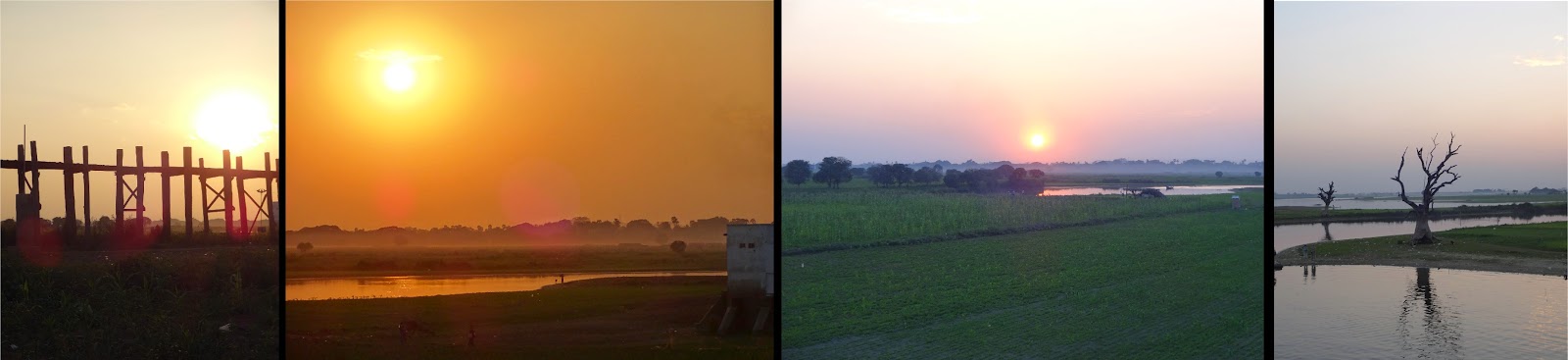
Incredible. Built sometime around 1850, the wooden bridge spans 1.2 kilometers (about 3/4 mile) across Taungthaman Lake. The bridge itself is very impressive. Just looking at it, it appears that the whole thing could collapse at any moment! The teakwood structure is actually quite strong. As we were walking along the bridge, we were approached by another monk! His English was impeccable and he had a lot of interesting information to share with us about the history of Myanmar, and the recent shift to allowing tourists to enter the country.

Grasshopper Adventures: Tea Shop, Foodie Tour


The tour was awesome! We all had our own bike drivers, and we rode in little stats facing backwards on the bike. We stopped at a roadside stand to grab some tempura, and then went off to a small restaurant on the edge of an open air market. The guide ordered us some mohinga, which is a fish and noodle dish traditionally eaten for breakfast. It was absolutely delicious. The empura we purchased on the way was to be eaten with the mohinga; making it noodely, salty, crunchy, and oh-so-satisfying!

We wandered over to the market and tried some home made tofu. We were taken into the market building, where there was a combination of food and textiles. It was a lot like the Korean markets. The next stop on the tour was a large tea shop where we were served tea and some dessert. The last stop was a shop where we could try the traditional green tea salad. It was probably the only thing that I had that I didn't absolutely love. It was fine, but everything else was just so fantastic, that the salad didn't quite stack up in my opinion.

Mandalay Palace


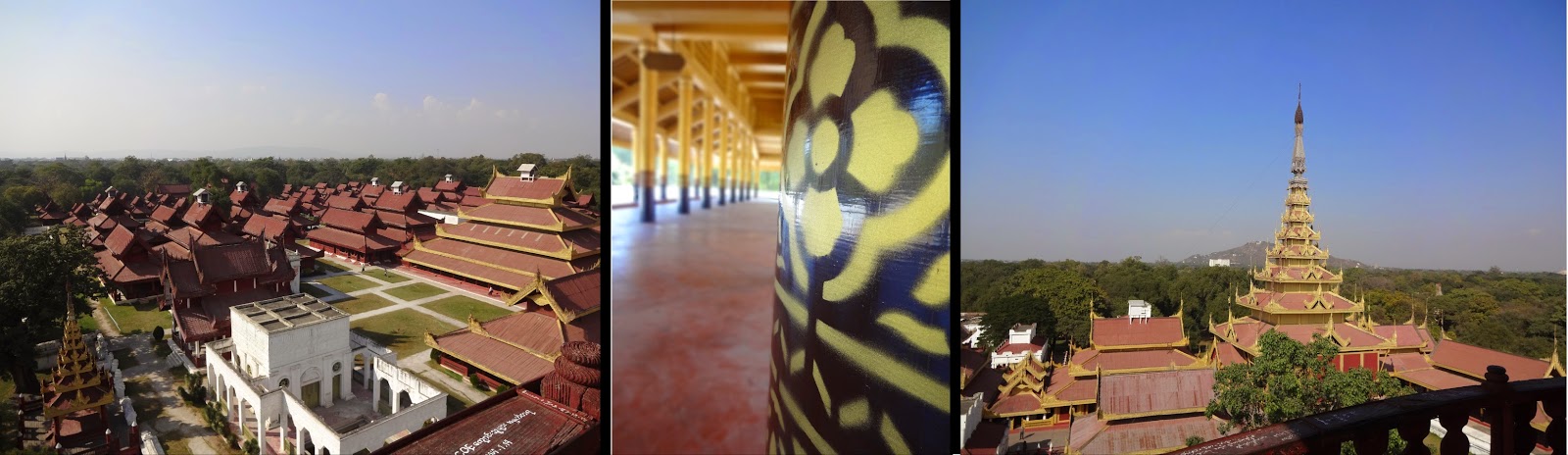
The palace complex is pretty well guarded. There are four 2km-long walls, only one of which has a public entrance. There are residents within the walls, and the actual palace is at the very center of the complex. Tourists are only permitted to travel down the straight road from the gate and into the palace area-- do not try to wander into the residential area!

The palace was beautiful, but eerily quiet. The architecture is similar to that of Thailand, so it wasn't as striking as it might have been if I hadn't previously seen similar buildings.

Shwenandaw Kyaung


Cool wooden monastery on the walk from the Palace to Mandalay Hill. Well worth popping in! It doesn't need more than about 15 minutes to explore and admire the wood wall carvings.

Kuthodaw Pagoda


Kuthodw Pagoda is a seriously cool attraction... and we almost missed it! We were rushing from the Mandalay Palace area to Mandalay Hill for sunset, and were going to walk past this gem, but decided cutting through would only add a few extra minutes. It looks a lot like all the other temples and pagodas in the area, but the small white stone structures hold a story. No, literally: a story! They hold large stone slabs with text engraved, and when read in sequence they create the world's largest book.

Mandalay Hill


Go to Mandalay Hill for sunset! It takes about 30 minutes to get to the top, and with somewhere around 1,700 stairs, make sure you bring water! There are posted signs all the way up saying "To The Top," and though it seems intuitive, it certainly is not. There are lots of landings and random rooms, the path twists a lot, and there are loads of Buddha statues. The view from the top is sensational. The tiles on the walls are colorful and reflective, and they catch the sunset beautifully.


NOTE: You should always remember to be mindful of where you are and the local culture. This is especially true in Myanmar. Keep covered and learn how to say thank you. You will be stared at and you will encounter people who don't speak English; learn how to handle it with grace or else postpone your trip until you can.